
Design of Riprap for Slope Protection against Wave Action
URS Corp., July, 2013
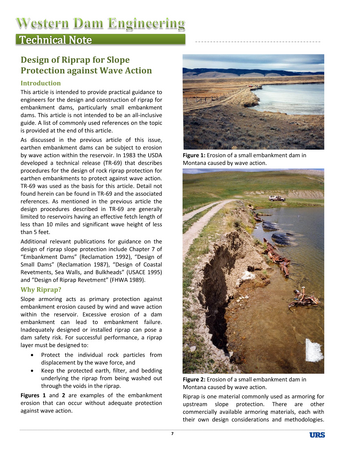
Design of Riprap for Slope Protection against Wave Action” provides practical guidance for the design and construction of riprap armoring on embankment dams, with a focus on small dams subject to wind-generated wave action. Wave-induced erosion of upstream embankment slopes can lead to progressive damage and, if left unaddressed, dam failure. The article builds on the wave prediction methods presented in a companion article and is primarily based on USDA Technical Release No. 69 (TR‑69), which applies to reservoirs with effective fetch lengths less than 10 miles and significant wave heights less than 5 feet.
The article explains that riprap serves as a primary erosion protection system by resisting wave forces that can displace embankment materials and by preventing underlying soils from being washed out through voids in the rock layer. For riprap to perform effectively, it must be sized to resist wave-induced forces and must be underlain by properly designed bedding and filter layers that retain embankment materials while allowing drainage. Inadequate design or installation of riprap can pose a significant dam safety risk.
A step-by-step design procedure is presented, beginning with determination of the required riprap rock weight based on embankment slope and significant wave height. TR‑69 equations and charts are used to estimate the median rock weight (W50), which is then converted to a representative rock size (D50). As wave height or slope steepness increases, larger and heavier rock is required to maintain stability. The article emphasizes the use of angular, durable, well-graded stone and discourages the use of rounded cobbles or boulders.
The article focuses on dumped (equipment-placed) riprap, noting that it generally provides superior performance and lower long-term maintenance costs compared to hand-placed rock. Using the calculated D50, designers determine appropriate gradation limits, riprap layer thickness (typically twice the D50), and any applicable safety factors based on dam hazard classification. Alternative methods and references for riprap sizing are cited for cases requiring additional conservatism or different design approaches.
Bedding and filter layers are discussed as essential components of a stable riprap system. The bedding layer provides a stable foundation for the riprap and acts as a filter-compatible transition between the riprap and finer embankment materials. Guidance is provided for bedding thickness based on riprap thickness, and the article notes that multi-stage filter systems may be required where large riprap is used. Proper filter compatibility is critical to preventing internal erosion and washout beneath the riprap.
The article also addresses the vertical and horizontal limits of riprap protection. The lower limit is typically set at 1.5 times the significant wave height below the normal reservoir water level or at the lowest controlled outlet elevation. The upper limit extends above the still water flood pool elevation by the sum of wind setup and wave runup. For existing dams with limited budgets, the article recommends prioritizing riprap placement in areas most susceptible to erosion, such as near structures, along prevailing wind directions, or where erosion has previously occurred.
Construction and placement considerations are emphasized, including the use of mechanical placement methods to avoid segregation, the importance of keying riprap into existing slopes when berms cannot be constructed, and the need for field adjustments and hand work to achieve a well-keyed, stable layer. The article concludes that properly designed and installed riprap, combined with compatible bedding and filters, provides effective long-term protection against wave-induced erosion of embankment dams.
This article was published in Vol. 1, Iss. 2 (July 2013) of Western Dam Engineering News and provides guidance on the design and construction of riprap for upstream slope protection against wave action at embankment dams. Western Dam Engineering News is a collaborative effort between the States of Colorado, Montana, New Mexico, and Wyoming and is funded by the FEMA National Dam Safety Act Assistance to States grant program. Special thanks to URS Corporation in Denver, Colorado for authoring the article.
Revision ID: 8331
Revision Date: 02/02/2026