
Design Considerations for Outlet Works Air Vents
URS Corp., July, 2013
Design Considerations for Outlet Works Air Vents” addresses the often misunderstood role of air venting in outlet works conduits and provides guidance for estimating air demand and sizing air vents for embankment dams. Proper air vent design is essential to maintaining stable hydraulic conditions downstream of control gates or valves, where low pressures commonly develop. Air vents allow atmospheric air to enter the conduit, reducing negative pressures, stabilizing flow, and allowing trapped air to be released prior to operation.
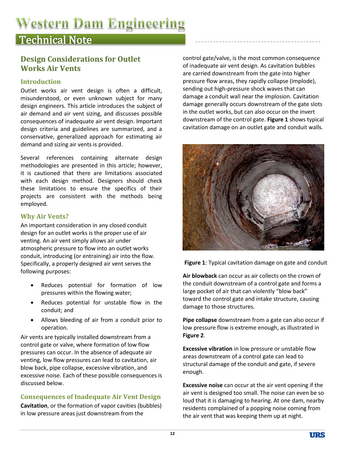
The article explains that inadequate air vent design can result in several serious operational and structural problems. These include cavitation damage to gates and conduit walls, air blowback toward the intake structure, collapse of conduit liners or pipes due to vacuum pressures, excessive vibration, and extreme noise at the air vent opening. These consequences underscore the importance of conservative air vent sizing, particularly for small to medium sized dams where oversized air vents generally have minimal cost or constructability impacts.
A central focus of the article is the concept of air demand, defined as the volume of air entrained into the flowing water through the air vent and, when unsubmerged, through the downstream outlet. Air demand is influenced by numerous variables, including gate opening, driving head, flow rate, flow regime, Froude number, conduit geometry and roughness, outlet submergence, air vent geometry, and altitude. Maximum air demand typically occurs at small gate openings under jet flow conditions and at large gate openings during free surface flow, while air demand is minimal when the conduit flows full or discharges directly to the atmosphere.
Because comprehensive analytical methods that account for all influencing variables are often impractical for typical dam projects, the article presents a generalized, conservative design approach suitable for small to medium sized dams. This approach relies on empirical relationships from published literature to estimate maximum air demand ratios for free surface flow and hydraulic jump conditions. Designers are encouraged to evaluate air demand near a 75 percent gate opening under maximum design head and to verify that the calculated airflow is on the same order as the design water flow rate. Once air demand is estimated, air vent size is determined by limiting air velocities to acceptable levels.
The article also summarizes alternative design methodologies from the U.S. Army Corps of Engineers, Bureau of Reclamation, and laboratory-based research studies. While these methods can offer more refined estimates, the article cautions that each has limitations related to geometry, flow conditions, and available data. Designers are advised to carefully assess the applicability of any method to their specific outlet works configuration.
Finally, the article provides practical air vent design criteria and construction guidelines. These include limiting air velocities to reduce noise, providing minimum vent diameters for maintenance, minimizing vent head losses, protecting vents from blockage and corrosion, and ensuring safe configurations for personnel and the public. A worked example demonstrates application of the conservative design method and illustrates typical air vent sizing for a small dam outlet works.
This article was published in Vol. 1, Iss. 2 (July 2013) of Western Dam Engineering News and discusses design considerations for outlet works air vents, including air demand estimation, conservative sizing approaches, and practical design guidelines. Western Dam Engineering News is a collaborative effort between the States of Colorado, Montana, New Mexico, and Wyoming and is funded by the FEMA National Dam Safety Act Assistance to States grant program. Special thanks to URS Corporation in Denver, Colorado for authoring the article.
Revision ID: 8330
Revision Date: 02/02/2026