
ER 1110-2-1806 Engineering and Design: Earthquake Analysis, Evaluation, and Design for Civil Works Projects
U.S. Army Corps of Engineers (USACE), June, 2024
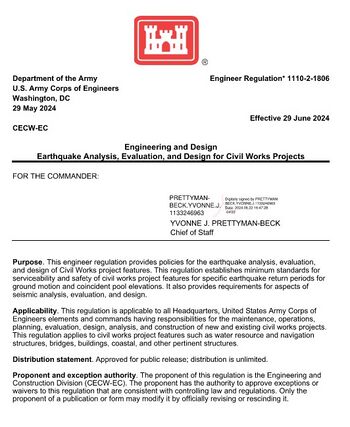
ER 1110-2-1806 (2024) establishes USACE policy for seismic analysis and design of Civil Works structures. It updates ground motion requirements, introduces formal coincident hydraulic loading criteria, refines consequence-based classification of project features, and strengthens risk-informed design practices. The regulation provides the framework for determining seismic demands (OBE, MDE, MCE), choosing appropriate analysis methods, developing performance criteria, and integrating geologic, geotechnical, hydraulic, and structural considerations into seismic evaluations. Critical structures face stricter requirements, including higher return-period ground motions and mandatory advanced analyses. The document aligns USACE practice with AASHTO standards, modern engineering manuals, and evolving seismic hazard science.
Document Download:
June, 2024 (current)
2016
1995 (Original)
Errata/Special Notes:
Key updates from 1995 (original) → 2016 version → 2024 current edition
- Document Status
- 1995 → 2016: 2016 edition supersedes the 1995 edition.
- 2016 → 2024: 2024 edition supersedes the 2016 edition.
- Seismic Performance Framework
- 1995 → 2016: Introduced OBE, MDE, and MCE definitions with associated performance expectations.
- 2016 → 2024: Updated OBE and MDE return periods; added formal aftershock requirements and slip-rate-based MCE criteria.
- Classification System
- 1995 → 2016: Introduced Hazard Potential Classification (Low, Significant, High).
- 2016 → 2024: Replaced with consequence‑based classification: Critical vs Non-Critical project features.
- Ground Motion Return Periods
- 1995 → 2016: Established OBE (~144 years) and MDE (~950 years) return periods; critical features used MCE.
- 2016 → 2024: Updated return periods:
- Non‑Critical → OBE 145-year, MDE 975-year
- Critical → OBE 475-year, MDE ≥2475-year or MCE-based
- Coincident Hydraulic Loading
- 1995 → 2016: No explicit requirement for coincident hydraulic loading in seismic analyses.
- 2016 → 2024: Introduced requirement to use coincident water surface elevation or hydraulic loading based on 10% annual duration exceedance.
- Seismic Studies
- 1995 → 2016: Added distinction between standard and site-specific seismic studies.
- 2016 → 2024: Tightened requirements for advanced studies, especially for Critical features.
- Analysis Methods
- 1995 → 2016: Established progressive analysis path (seismic coefficient → response spectrum → time history).
- 2016 → 2024: Requires advanced methods for Critical features and limits simplified methods to screening-level use.
- Hazard Region Definition
- 1995 → 2016: Hazard regions based on USGS seismic hazard maps.
- 2016 → 2024: Hazard regions defined numerically by PGA thresholds (≤0.1g, 0.1–0.2g, ≥0.2g).
- Buildings and Bridges
- 1995 → 2016: Required use of IBC for buildings and AASHTO/FHWA for bridges.
- 2016 → 2024: Added requirements for structures on dam/levee crests and alignment with appurtenant-structure performance rules.
- Appurtenant Structures
- 1995 → 2016: Limited specific operability requirements beyond hydraulic steel structure guidance.
- 2016 → 2024: Required to remain operable after major earthquakes if needed for reservoir drawdown or levee closure.
- Fault Rupture, Landslides, and Seiche
- 1995 → 2016: Addressed liquefaction and slope stability but without explicit requirements for seiche or fault-rupture displacement.
- 2016 → 2024: Requires analysis of fault rupture within 30 km, pre‑existing landslide triggering, and seiche effects.
- Risk-Informed Design
- 1995 → 2016: Introduced high-level integration with existing risk guidelines.
- 2016 → 2024: Deep integration of risk-informed design, including system response functions and consequences-driven performance criteria.
- Document Architecture
- 1995 → 2016: Included detailed appendices with methods, analysis progression, and report templates.
- 2016 → 2024: Removed guidance content and relocated it to Engineer Manuals; ER refocuses strictly on required policy and criteria.
Revision ID: 8345
Revision Date: 02/23/2026