
Irrigation: Difference between revisions
No edit summary |
(Expanded) |
||
| Line 16: | Line 16: | ||
}} | }} | ||
Ten percent of American cropland is irrigated using water stored behind dams. Dams can be used to both store water and divert it to where it is needed for crops or livestock. | Ten percent of American cropland is irrigated using water stored behind dams. Dams can be used to both store water and divert it to where it is needed for crops or livestock. For example, in arid regions, adjacent watersheds generally experience higher [[precipitation]] in winter and spring than in the summer and fall. Water from [[snowmelt]] and rainfall can be stored during these wetter months then released during the drier months. This helps growers plan their crops, prolongs the growing season, and increases agricultural production. Growers supplied with such irrigation can rely less on pumping [[groundwater]] for irrigation, which consumes energy and can lead to groundwater overdraft and land subsidence. | ||
Some guidance for these [[Types of Dams|types of dams]] can be found at: | Some guidance for these [[Types of Dams|types of dams]] can be found at: | ||
Latest revision as of 22:00, 2 March 2026
|
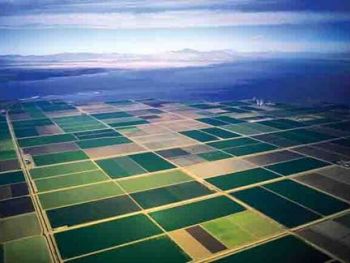
| Irrigation from dams and related infrastructure has made desert agriculture feasible
(Image Source: Wikipedia) |
Ten percent of American cropland is irrigated using water stored behind dams. Dams can be used to both store water and divert it to where it is needed for crops or livestock. For example, in arid regions, adjacent watersheds generally experience higher precipitation in winter and spring than in the summer and fall. Water from snowmelt and rainfall can be stored during these wetter months then released during the drier months. This helps growers plan their crops, prolongs the growing season, and increases agricultural production. Growers supplied with such irrigation can rely less on pumping groundwater for irrigation, which consumes energy and can lead to groundwater overdraft and land subsidence.
Some guidance for these types of dams can be found at:
USDA Irrigation Reservoir Code https://www.nrcs.usda.gov/sites/default/files/2022-09/Irrigation_Reservoir_436_CPS_9_2020.pdf
Revision ID: 8352
Revision Date: 03/02/2026