
Environment: Difference between revisions
No edit summary |
(Expanded, removed redundant sentence) |
||
| Line 12: | Line 12: | ||
|caption= | |caption= | ||
The bald eagle, a migratory bird, is known to nest near dams | |||
(Image Source: [https://en.wikipedia.org/wiki/Bald_eagle Wikipedia]) | (Image Source: [https://en.wikipedia.org/wiki/Bald_eagle Wikipedia]) | ||
}} | }} | ||
[[Reservoirs]] and the dams that create them can greatly impact the natural environment. Still, the principal impact comes from the work needed to construct the dam and from the initial impoundment of water. Once that has taken place, reservoirs provide different [[environmental]] benefits. For example, reservoirs support aquatic plants and animals. Surrounding lands can support migratory birds which feed on fish. Proposed dams generally change streams both upstream and downstream from where they are constructed, and the lands inundated by the reservoir are no longer available for land plants and animals, as does the development of large expanses of land for cities and crops. Society must weigh the benefits provided by dams against these tradeoffs. | |||
Some guidance on how to design reservoirs to mitigate their impacts: | |||
[https://files.worldwildlife.org/wwfcmsprod/files/Publication/file/1sugf98ujw_Guidance_Note_on_Projects_Relating_to_Dams.pdf World Wildlife Foundation] | |||
[https://www.epa.gov/sites/default/files/2015-09/documents/chapter_4_dams_web.pdf United States Environmental Protection Administration] | |||
<!-- Revision history information --> | <!-- Revision history information --> | ||
{{revhistinf}} | {{revhistinf}} | ||
Latest revision as of 21:52, 2 March 2026
|
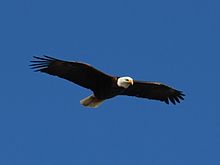
| The bald eagle, a migratory bird, is known to nest near dams
(Image Source: Wikipedia) |
Reservoirs and the dams that create them can greatly impact the natural environment. Still, the principal impact comes from the work needed to construct the dam and from the initial impoundment of water. Once that has taken place, reservoirs provide different environmental benefits. For example, reservoirs support aquatic plants and animals. Surrounding lands can support migratory birds which feed on fish. Proposed dams generally change streams both upstream and downstream from where they are constructed, and the lands inundated by the reservoir are no longer available for land plants and animals, as does the development of large expanses of land for cities and crops. Society must weigh the benefits provided by dams against these tradeoffs.
Some guidance on how to design reservoirs to mitigate their impacts:
United States Environmental Protection Administration
Revision ID: 8351
Revision Date: 03/02/2026